
I recently got into studying binary exploitation mainly cause I was planning to take a course on it this semester. However due to conflicting schedules with other courses I wasn’t able to take it. Oh well, anyway I made this blog post mainly as a way to test my knowledge but also to help others who wanted to get into studying pwn. I am by no means good at pwning but sometimes I feel like its better that way if I’m making a beginner friendly blog post. This blog post only assumes one thing : you know how to read C. One thing to note is that is post is strictly about x86 64 bit architecture, things will be different on different architecture. With that out of the way, let’s start!
Registers
So what are registers? Well to put it simply, a register is just a location within the processor that is used to store data, much like RAM. The difference is that registers are smaller and faster. Registers could be differentiated into two groups, general purpose registers (GPRs) and special purpose registers (SPRs). SPRs are registered that are reserved for certain tasks while GPRs can be used for any task but some of them have some special purposes for functions. In 64 bit architecutre, a register is 64 bit (8 bytes) in size. To make it clear here is a table of all the registers
SPRs
| Register | Purpose |
|---|---|
rip | points to the address of the next instruction to execute |
rsp | points to the bottom of the stack frame |
GPRs
”-” means no conventional purpose
| Register | Convential Purpose |
|---|---|
rax | return value |
rbx | - |
rdi | 1st integer/pointer argument |
rsi | 2nd integer/pointer argument |
rdx | 3rd integer/pointer argument |
rcx | 4th integer/pointer argument |
r8 | 5th integer/pointer argument |
r9 | 6th integer/pointer argument |
r10 - r15 | - |
rbp | points to the top of the stack frame |
Fun Fact
Although in 64 bit arch a register is 64 bit in size, we are able to reference difference sizes. For example, the lower 32 bit of the rax register can be referenced by eax. I won’t go into too much for this topic, you could google around if you’re interested
Stack
A stack is simply a region in memory. Similar to the stack data structure, we have 2 operations we can do on the stack, push and pop. Push will push something into the stack and pop will pop something off from the stack. And in case you don’t know, a stack has LIFO (last in first out) property. Imagine a stack of books, the last book you add to the stack will be the first book you take off.
There are two main registers that are used for the stack, rsp and rbp. If you look back at the table above, rbp points to the top of the stack frame and rsp points to the bottom (if you’re confused what a stack frame is, don’t worry we’ll get into that soon). Whever we push to the stack rsp decreases by 8 while when we pop the opposite happens. You might be wondering why pushing the stack decreases rsp instead of increasing it. This is because the stack actually grows into region of lower memory.
The stack has many purposes but for this post we’ll focus on how the stack is used to manage function calls and local variables.
To help us, we’ll use the following c program
#include <stdio.h>
int inc(long number) { long incrementer = 1; long result = number + incrementer; return result;}
int main() { inc(5); return 0;}The best way to understand how functions use the stack is to view the diassembly of the function. We can use objdump to easily do that
95 collapsed lines
test_program: file format elf64-x86-64
Disassembly of section .init:
0000000000001000 <_init>: 1000: f3 0f 1e fa endbr64 1004: 48 83 ec 08 sub rsp,0x8 1008: 48 8b 05 c1 2f 00 00 mov rax,QWORD PTR [rip+0x2fc1] # 3fd0 <__gmon_start__@Base> 100f: 48 85 c0 test rax,rax 1012: /-- 74 02 je 1016 <_init+0x16> 1014: | ff d0 call rax 1016: \-> 48 83 c4 08 add rsp,0x8 101a: c3 ret
Disassembly of section .plt:
0000000000001020 <.plt>: 1020: ff 35 ca 2f 00 00 push QWORD PTR [rip+0x2fca] # 3ff0 <_GLOBAL_OFFSET_TABLE_+0x8> 1026: ff 25 cc 2f 00 00 jmp QWORD PTR [rip+0x2fcc] # 3ff8 <_GLOBAL_OFFSET_TABLE_+0x10> 102c: 0f 1f 40 00 nop DWORD PTR [rax+0x0]
Disassembly of section .plt.got:
0000000000001030 <__cxa_finalize@plt>: 1030: ff 25 aa 2f 00 00 jmp QWORD PTR [rip+0x2faa] # 3fe0 <__cxa_finalize@GLIBC_2.2.5> 1036: 66 90 xchg ax,ax
Disassembly of section .text:
0000000000001040 <_start>: 1040: f3 0f 1e fa endbr64 1044: 31 ed xor ebp,ebp 1046: 49 89 d1 mov r9,rdx 1049: 5e pop rsi 104a: 48 89 e2 mov rdx,rsp 104d: 48 83 e4 f0 and rsp,0xfffffffffffffff0 1051: 50 push rax 1052: 54 push rsp 1053: 45 31 c0 xor r8d,r8d 1056: 31 c9 xor ecx,ecx 1058: 48 8d 3d c7 00 00 00 lea rdi,[rip+0xc7] # 1126 <main> 105f: ff 15 5b 2f 00 00 call QWORD PTR [rip+0x2f5b] # 3fc0 <__libc_start_main@GLIBC_2.34> 1065: f4 hlt
0000000000001066 <deregister_tm_clones>: 1066: 48 8d 3d a3 2f 00 00 lea rdi,[rip+0x2fa3] # 4010 <__TMC_END__> 106d: 48 8d 05 9c 2f 00 00 lea rax,[rip+0x2f9c] # 4010 <__TMC_END__> 1074: 48 39 f8 cmp rax,rdi 1077: /-- 74 0e je 1087 <deregister_tm_clones+0x21> 1079: | 48 8b 05 48 2f 00 00 mov rax,QWORD PTR [rip+0x2f48] # 3fc8 <_ITM_deregisterTMCloneTable@Base> 1080: | 48 85 c0 test rax,rax 1083: +-- 74 02 je 1087 <deregister_tm_clones+0x21> 1085: | ff e0 jmp rax 1087: \-> c3 ret
0000000000001088 <register_tm_clones>: 1088: 48 8d 3d 81 2f 00 00 lea rdi,[rip+0x2f81] # 4010 <__TMC_END__> 108f: 48 8d 35 7a 2f 00 00 lea rsi,[rip+0x2f7a] # 4010 <__TMC_END__> 1096: b9 02 00 00 00 mov ecx,0x2 109b: 48 29 fe sub rsi,rdi 109e: 48 c1 fe 03 sar rsi,0x3 10a2: 48 89 f0 mov rax,rsi 10a5: 48 99 cqo 10a7: 48 f7 f9 idiv rcx 10aa: 48 89 c6 mov rsi,rax 10ad: 48 85 c0 test rax,rax 10b0: /-- 74 0e je 10c0 <register_tm_clones+0x38> 10b2: | 48 8b 05 1f 2f 00 00 mov rax,QWORD PTR [rip+0x2f1f] # 3fd8 <_ITM_registerTMCloneTable@Base> 10b9: | 48 85 c0 test rax,rax 10bc: +-- 74 02 je 10c0 <register_tm_clones+0x38> 10be: | ff e0 jmp rax 10c0: \-> c3 ret
00000000000010c1 <__do_global_dtors_aux>: 10c1: f3 0f 1e fa endbr64 10c5: 80 3d 44 2f 00 00 00 cmp BYTE PTR [rip+0x2f44],0x0 # 4010 <__TMC_END__> 10cc: /----- 75 28 jne 10f6 <__do_global_dtors_aux+0x35> 10ce: | 55 push rbp 10cf: | 48 83 3d 09 2f 00 00 cmp QWORD PTR [rip+0x2f09],0x0 # 3fe0 <__cxa_finalize@GLIBC_2.2.5> 10d6: | 00 10d7: | 48 89 e5 mov rbp,rsp 10da: | /-- 74 0c je 10e8 <__do_global_dtors_aux+0x27> 10dc: | | 48 8b 3d 25 2f 00 00 mov rdi,QWORD PTR [rip+0x2f25] # 4008 <__dso_handle> 10e3: | | e8 48 ff ff ff call 1030 <__cxa_finalize@plt> 10e8: | \-> e8 79 ff ff ff call 1066 <deregister_tm_clones> 10ed: | c6 05 1c 2f 00 00 01 mov BYTE PTR [rip+0x2f1c],0x1 # 4010 <__TMC_END__> 10f4: | 5d pop rbp 10f5: | c3 ret 10f6: \----> c3 ret
00000000000010f7 <frame_dummy>: 10f7: f3 0f 1e fa endbr64 10fb: eb 8b jmp 1088 <register_tm_clones>
00000000000010fd <inc>: 10fd: 55 push rbp 10fe: 48 89 e5 mov rbp,rsp 1101: 48 83 ec 18 sub rsp,0x18 1105: 48 89 7d e8 mov QWORD PTR [rbp-0x18],rdi 1109: 48 c7 45 f8 01 00 00 mov QWORD PTR [rbp-0x8],0x1 1110: 00 1111: 48 8b 55 e8 mov rdx,QWORD PTR [rbp-0x18] 1115: 48 8b 45 f8 mov rax,QWORD PTR [rbp-0x8] 1119: 48 01 d0 add rax,rdx 111c: 48 89 45 f0 mov QWORD PTR [rbp-0x10],rax 1120: 48 8b 45 f0 mov rax,QWORD PTR [rbp-0x10] 1124: c9 leave 1125: c3 ret
0000000000001126 <main>: 1126: 55 push rbp 1127: 48 89 e5 mov rbp,rsp 112a: bf 05 00 00 00 mov edi,0x5 112f: e8 c9 ff ff ff call 10fd <inc> 1134: b8 00 00 00 00 mov eax,0x0 1139: 5d pop rbp 113a: c3 ret8 collapsed lines
Disassembly of section .fini:
000000000000113c <_fini>: 113c: f3 0f 1e fa endbr64 1140: 48 83 ec 08 sub rsp,0x8 1144: 48 83 c4 08 add rsp,0x8 1148: c3 retFun Fact
In order to make this example work, I had to compile the program using the -mno-red-zone tag. This is because on modern Linux ABI there is something called the “red zone”. You could learn more about that here
Stack Frame
As I mentioned earlier, functions use the stack for a lot of things but the one we’ll focus on here is local variables. Each function will have its own dedicated stack frame. That means that all local variables, buffer, and etc will reside in that stack frame. Every function could be generally seperated into 3 parts, the prolouge, function body, and epilogue. On the prolouge the function would setup its stack frame, on the function body it will does whatever the function does, and on the epilouge it will tear down its stack frame.
95 collapsed lines
test_program: file format elf64-x86-64
Disassembly of section .init:
0000000000001000 <_init>: 1000: f3 0f 1e fa endbr64 1004: 48 83 ec 08 sub rsp,0x8 1008: 48 8b 05 c1 2f 00 00 mov rax,QWORD PTR [rip+0x2fc1] # 3fd0 <__gmon_start__@Base> 100f: 48 85 c0 test rax,rax 1012: /-- 74 02 je 1016 <_init+0x16> 1014: | ff d0 call rax 1016: \-> 48 83 c4 08 add rsp,0x8 101a: c3 ret
Disassembly of section .plt:
0000000000001020 <.plt>: 1020: ff 35 ca 2f 00 00 push QWORD PTR [rip+0x2fca] # 3ff0 <_GLOBAL_OFFSET_TABLE_+0x8> 1026: ff 25 cc 2f 00 00 jmp QWORD PTR [rip+0x2fcc] # 3ff8 <_GLOBAL_OFFSET_TABLE_+0x10> 102c: 0f 1f 40 00 nop DWORD PTR [rax+0x0]
Disassembly of section .plt.got:
0000000000001030 <__cxa_finalize@plt>: 1030: ff 25 aa 2f 00 00 jmp QWORD PTR [rip+0x2faa] # 3fe0 <__cxa_finalize@GLIBC_2.2.5> 1036: 66 90 xchg ax,ax
Disassembly of section .text:
0000000000001040 <_start>: 1040: f3 0f 1e fa endbr64 1044: 31 ed xor ebp,ebp 1046: 49 89 d1 mov r9,rdx 1049: 5e pop rsi 104a: 48 89 e2 mov rdx,rsp 104d: 48 83 e4 f0 and rsp,0xfffffffffffffff0 1051: 50 push rax 1052: 54 push rsp 1053: 45 31 c0 xor r8d,r8d 1056: 31 c9 xor ecx,ecx 1058: 48 8d 3d c7 00 00 00 lea rdi,[rip+0xc7] # 1126 <main> 105f: ff 15 5b 2f 00 00 call QWORD PTR [rip+0x2f5b] # 3fc0 <__libc_start_main@GLIBC_2.34> 1065: f4 hlt
0000000000001066 <deregister_tm_clones>: 1066: 48 8d 3d a3 2f 00 00 lea rdi,[rip+0x2fa3] # 4010 <__TMC_END__> 106d: 48 8d 05 9c 2f 00 00 lea rax,[rip+0x2f9c] # 4010 <__TMC_END__> 1074: 48 39 f8 cmp rax,rdi 1077: /-- 74 0e je 1087 <deregister_tm_clones+0x21> 1079: | 48 8b 05 48 2f 00 00 mov rax,QWORD PTR [rip+0x2f48] # 3fc8 <_ITM_deregisterTMCloneTable@Base> 1080: | 48 85 c0 test rax,rax 1083: +-- 74 02 je 1087 <deregister_tm_clones+0x21> 1085: | ff e0 jmp rax 1087: \-> c3 ret
0000000000001088 <register_tm_clones>: 1088: 48 8d 3d 81 2f 00 00 lea rdi,[rip+0x2f81] # 4010 <__TMC_END__> 108f: 48 8d 35 7a 2f 00 00 lea rsi,[rip+0x2f7a] # 4010 <__TMC_END__> 1096: b9 02 00 00 00 mov ecx,0x2 109b: 48 29 fe sub rsi,rdi 109e: 48 c1 fe 03 sar rsi,0x3 10a2: 48 89 f0 mov rax,rsi 10a5: 48 99 cqo 10a7: 48 f7 f9 idiv rcx 10aa: 48 89 c6 mov rsi,rax 10ad: 48 85 c0 test rax,rax 10b0: /-- 74 0e je 10c0 <register_tm_clones+0x38> 10b2: | 48 8b 05 1f 2f 00 00 mov rax,QWORD PTR [rip+0x2f1f] # 3fd8 <_ITM_registerTMCloneTable@Base> 10b9: | 48 85 c0 test rax,rax 10bc: +-- 74 02 je 10c0 <register_tm_clones+0x38> 10be: | ff e0 jmp rax 10c0: \-> c3 ret
00000000000010c1 <__do_global_dtors_aux>: 10c1: f3 0f 1e fa endbr64 10c5: 80 3d 44 2f 00 00 00 cmp BYTE PTR [rip+0x2f44],0x0 # 4010 <__TMC_END__> 10cc: /----- 75 28 jne 10f6 <__do_global_dtors_aux+0x35> 10ce: | 55 push rbp 10cf: | 48 83 3d 09 2f 00 00 cmp QWORD PTR [rip+0x2f09],0x0 # 3fe0 <__cxa_finalize@GLIBC_2.2.5> 10d6: | 00 10d7: | 48 89 e5 mov rbp,rsp 10da: | /-- 74 0c je 10e8 <__do_global_dtors_aux+0x27> 10dc: | | 48 8b 3d 25 2f 00 00 mov rdi,QWORD PTR [rip+0x2f25] # 4008 <__dso_handle> 10e3: | | e8 48 ff ff ff call 1030 <__cxa_finalize@plt> 10e8: | \-> e8 79 ff ff ff call 1066 <deregister_tm_clones> 10ed: | c6 05 1c 2f 00 00 01 mov BYTE PTR [rip+0x2f1c],0x1 # 4010 <__TMC_END__> 10f4: | 5d pop rbp 10f5: | c3 ret 10f6: \----> c3 ret
00000000000010f7 <frame_dummy>: 10f7: f3 0f 1e fa endbr64 10fb: eb 8b jmp 1088 <register_tm_clones>
00000000000010fd <inc>:
10fd: 55 push rbp 10fe: 48 89 e5 mov rbp,rsp 1101: 48 83 ec 18 sub rsp,0x18 1105: 48 89 7d e8 mov QWORD PTR [rbp-0x18],rdi 1109: 48 c7 45 f8 01 00 00 mov QWORD PTR [rbp-0x8],0x1 1110: 00 1111: 48 8b 55 e8 mov rdx,QWORD PTR [rbp-0x18] 1115: 48 8b 45 f8 mov rax,QWORD PTR [rbp-0x8] 1119: 48 01 d0 add rax,rdx 111c: 48 89 45 f0 mov QWORD PTR [rbp-0x10],rax 1120: 48 8b 45 f0 mov rax,QWORD PTR [rbp-0x10]
1124: c9 leave 1125: c3 ret
0000000000001126 <main>: 1126: 55 push rbp 1127: 48 89 e5 mov rbp,rsp 112a: bf 05 00 00 00 mov edi,0x5 112f: e8 c9 ff ff ff call 10fd <inc> 1134: b8 00 00 00 00 mov eax,0x0 1139: 5d pop rbp 113a: c3 ret8 collapsed lines
Disassembly of section .fini:
000000000000113c <_fini>: 113c: f3 0f 1e fa endbr64 1140: 48 83 ec 08 sub rsp,0x8 1144: 48 83 c4 08 add rsp,0x8 1148: c3 retCalling Functions
So what happens when we call a function? Let’s take a look at the call instruction on main
112 collapsed lines
test_program: file format elf64-x86-64
Disassembly of section .init:
0000000000001000 <_init>: 1000: f3 0f 1e fa endbr64 1004: 48 83 ec 08 sub rsp,0x8 1008: 48 8b 05 c1 2f 00 00 mov rax,QWORD PTR [rip+0x2fc1] # 3fd0 <__gmon_start__@Base> 100f: 48 85 c0 test rax,rax 1012: /-- 74 02 je 1016 <_init+0x16> 1014: | ff d0 call rax 1016: \-> 48 83 c4 08 add rsp,0x8 101a: c3 ret
Disassembly of section .plt:
0000000000001020 <.plt>: 1020: ff 35 ca 2f 00 00 push QWORD PTR [rip+0x2fca] # 3ff0 <_GLOBAL_OFFSET_TABLE_+0x8> 1026: ff 25 cc 2f 00 00 jmp QWORD PTR [rip+0x2fcc] # 3ff8 <_GLOBAL_OFFSET_TABLE_+0x10> 102c: 0f 1f 40 00 nop DWORD PTR [rax+0x0]
Disassembly of section .plt.got:
0000000000001030 <__cxa_finalize@plt>: 1030: ff 25 aa 2f 00 00 jmp QWORD PTR [rip+0x2faa] # 3fe0 <__cxa_finalize@GLIBC_2.2.5> 1036: 66 90 xchg ax,ax
Disassembly of section .text:
0000000000001040 <_start>: 1040: f3 0f 1e fa endbr64 1044: 31 ed xor ebp,ebp 1046: 49 89 d1 mov r9,rdx 1049: 5e pop rsi 104a: 48 89 e2 mov rdx,rsp 104d: 48 83 e4 f0 and rsp,0xfffffffffffffff0 1051: 50 push rax 1052: 54 push rsp 1053: 45 31 c0 xor r8d,r8d 1056: 31 c9 xor ecx,ecx 1058: 48 8d 3d c7 00 00 00 lea rdi,[rip+0xc7] # 1126 <main> 105f: ff 15 5b 2f 00 00 call QWORD PTR [rip+0x2f5b] # 3fc0 <__libc_start_main@GLIBC_2.34> 1065: f4 hlt
0000000000001066 <deregister_tm_clones>: 1066: 48 8d 3d a3 2f 00 00 lea rdi,[rip+0x2fa3] # 4010 <__TMC_END__> 106d: 48 8d 05 9c 2f 00 00 lea rax,[rip+0x2f9c] # 4010 <__TMC_END__> 1074: 48 39 f8 cmp rax,rdi 1077: /-- 74 0e je 1087 <deregister_tm_clones+0x21> 1079: | 48 8b 05 48 2f 00 00 mov rax,QWORD PTR [rip+0x2f48] # 3fc8 <_ITM_deregisterTMCloneTable@Base> 1080: | 48 85 c0 test rax,rax 1083: +-- 74 02 je 1087 <deregister_tm_clones+0x21> 1085: | ff e0 jmp rax 1087: \-> c3 ret
0000000000001088 <register_tm_clones>: 1088: 48 8d 3d 81 2f 00 00 lea rdi,[rip+0x2f81] # 4010 <__TMC_END__> 108f: 48 8d 35 7a 2f 00 00 lea rsi,[rip+0x2f7a] # 4010 <__TMC_END__> 1096: b9 02 00 00 00 mov ecx,0x2 109b: 48 29 fe sub rsi,rdi 109e: 48 c1 fe 03 sar rsi,0x3 10a2: 48 89 f0 mov rax,rsi 10a5: 48 99 cqo 10a7: 48 f7 f9 idiv rcx 10aa: 48 89 c6 mov rsi,rax 10ad: 48 85 c0 test rax,rax 10b0: /-- 74 0e je 10c0 <register_tm_clones+0x38> 10b2: | 48 8b 05 1f 2f 00 00 mov rax,QWORD PTR [rip+0x2f1f] # 3fd8 <_ITM_registerTMCloneTable@Base> 10b9: | 48 85 c0 test rax,rax 10bc: +-- 74 02 je 10c0 <register_tm_clones+0x38> 10be: | ff e0 jmp rax 10c0: \-> c3 ret
00000000000010c1 <__do_global_dtors_aux>: 10c1: f3 0f 1e fa endbr64 10c5: 80 3d 44 2f 00 00 00 cmp BYTE PTR [rip+0x2f44],0x0 # 4010 <__TMC_END__> 10cc: /----- 75 28 jne 10f6 <__do_global_dtors_aux+0x35> 10ce: | 55 push rbp 10cf: | 48 83 3d 09 2f 00 00 cmp QWORD PTR [rip+0x2f09],0x0 # 3fe0 <__cxa_finalize@GLIBC_2.2.5> 10d6: | 00 10d7: | 48 89 e5 mov rbp,rsp 10da: | /-- 74 0c je 10e8 <__do_global_dtors_aux+0x27> 10dc: | | 48 8b 3d 25 2f 00 00 mov rdi,QWORD PTR [rip+0x2f25] # 4008 <__dso_handle> 10e3: | | e8 48 ff ff ff call 1030 <__cxa_finalize@plt> 10e8: | \-> e8 79 ff ff ff call 1066 <deregister_tm_clones> 10ed: | c6 05 1c 2f 00 00 01 mov BYTE PTR [rip+0x2f1c],0x1 # 4010 <__TMC_END__> 10f4: | 5d pop rbp 10f5: | c3 ret 10f6: \----> c3 ret
00000000000010f7 <frame_dummy>: 10f7: f3 0f 1e fa endbr64 10fb: eb 8b jmp 1088 <register_tm_clones>
00000000000010fd <inc>:
10fd: 55 push rbp 10fe: 48 89 e5 mov rbp,rsp 1101: 48 83 ec 18 sub rsp,0x18 1105: 48 89 7d e8 mov QWORD PTR [rbp-0x18],rdi 1109: 48 c7 45 f8 01 00 00 mov QWORD PTR [rbp-0x8],0x1 1110: 00 1111: 48 8b 55 e8 mov rdx,QWORD PTR [rbp-0x18] 1115: 48 8b 45 f8 mov rax,QWORD PTR [rbp-0x8] 1119: 48 01 d0 add rax,rdx 111c: 48 89 45 f0 mov QWORD PTR [rbp-0x10],rax 1120: 48 8b 45 f0 mov rax,QWORD PTR [rbp-0x10]
1124: c9 leave 1125: c3 ret
0000000000001126 <main>: 1126: 55 push rbp 1127: 48 89 e5 mov rbp,rsp 112a: bf 05 00 00 00 mov edi,0x5 112f: e8 c9 ff ff ff call 10fd <inc> 1134: b8 00 00 00 00 mov eax,0x0 1139: 5d pop rbp 113a: c3 ret8 collapsed lines
Disassembly of section .fini:
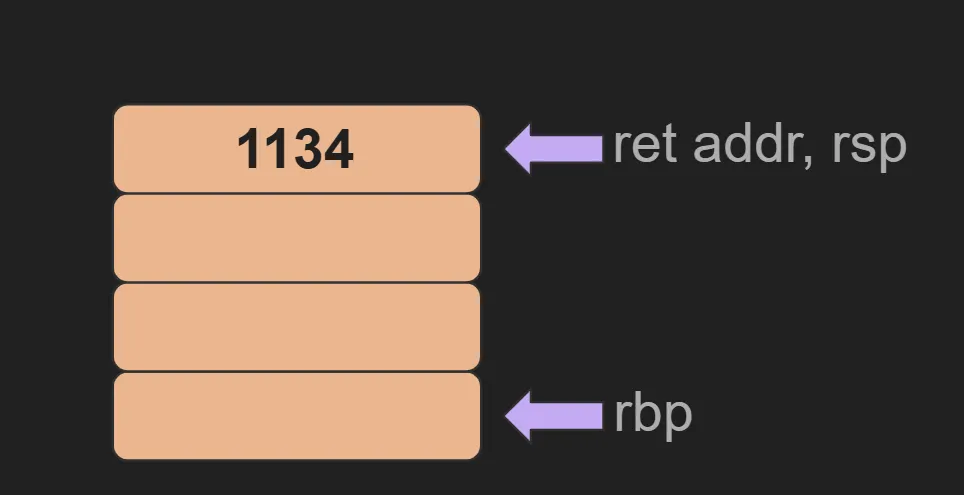
000000000000113c <_fini>: 113c: f3 0f 1e fa endbr64 1140: 48 83 ec 08 sub rsp,0x8 1144: 48 83 c4 08 add rsp,0x8 1148: c3 retThe call function does 2 things, first it pushes the address of the instruction after it to the stack, then it jumps to the address of the function it is calling. So in this case it will push 1134 to the stack, then jumps to inc. The address 1134 is called the return address because that is where the program will jump to after the inc function has finished executing. Visually, here is what the stack looks like after the call function
Prolouge
After we jump to inc we enter the Prolouge. Let’s take a look at what the Prolouge does
95 collapsed lines
test_program: file format elf64-x86-64
Disassembly of section .init:
0000000000001000 <_init>: 1000: f3 0f 1e fa endbr64 1004: 48 83 ec 08 sub rsp,0x8 1008: 48 8b 05 c1 2f 00 00 mov rax,QWORD PTR [rip+0x2fc1] # 3fd0 <__gmon_start__@Base> 100f: 48 85 c0 test rax,rax 1012: /-- 74 02 je 1016 <_init+0x16> 1014: | ff d0 call rax 1016: \-> 48 83 c4 08 add rsp,0x8 101a: c3 ret
Disassembly of section .plt:
0000000000001020 <.plt>: 1020: ff 35 ca 2f 00 00 push QWORD PTR [rip+0x2fca] # 3ff0 <_GLOBAL_OFFSET_TABLE_+0x8> 1026: ff 25 cc 2f 00 00 jmp QWORD PTR [rip+0x2fcc] # 3ff8 <_GLOBAL_OFFSET_TABLE_+0x10> 102c: 0f 1f 40 00 nop DWORD PTR [rax+0x0]
Disassembly of section .plt.got:
0000000000001030 <__cxa_finalize@plt>: 1030: ff 25 aa 2f 00 00 jmp QWORD PTR [rip+0x2faa] # 3fe0 <__cxa_finalize@GLIBC_2.2.5> 1036: 66 90 xchg ax,ax
Disassembly of section .text:
0000000000001040 <_start>: 1040: f3 0f 1e fa endbr64 1044: 31 ed xor ebp,ebp 1046: 49 89 d1 mov r9,rdx 1049: 5e pop rsi 104a: 48 89 e2 mov rdx,rsp 104d: 48 83 e4 f0 and rsp,0xfffffffffffffff0 1051: 50 push rax 1052: 54 push rsp 1053: 45 31 c0 xor r8d,r8d 1056: 31 c9 xor ecx,ecx 1058: 48 8d 3d c7 00 00 00 lea rdi,[rip+0xc7] # 1126 <main> 105f: ff 15 5b 2f 00 00 call QWORD PTR [rip+0x2f5b] # 3fc0 <__libc_start_main@GLIBC_2.34> 1065: f4 hlt
0000000000001066 <deregister_tm_clones>: 1066: 48 8d 3d a3 2f 00 00 lea rdi,[rip+0x2fa3] # 4010 <__TMC_END__> 106d: 48 8d 05 9c 2f 00 00 lea rax,[rip+0x2f9c] # 4010 <__TMC_END__> 1074: 48 39 f8 cmp rax,rdi 1077: /-- 74 0e je 1087 <deregister_tm_clones+0x21> 1079: | 48 8b 05 48 2f 00 00 mov rax,QWORD PTR [rip+0x2f48] # 3fc8 <_ITM_deregisterTMCloneTable@Base> 1080: | 48 85 c0 test rax,rax 1083: +-- 74 02 je 1087 <deregister_tm_clones+0x21> 1085: | ff e0 jmp rax 1087: \-> c3 ret
0000000000001088 <register_tm_clones>: 1088: 48 8d 3d 81 2f 00 00 lea rdi,[rip+0x2f81] # 4010 <__TMC_END__> 108f: 48 8d 35 7a 2f 00 00 lea rsi,[rip+0x2f7a] # 4010 <__TMC_END__> 1096: b9 02 00 00 00 mov ecx,0x2 109b: 48 29 fe sub rsi,rdi 109e: 48 c1 fe 03 sar rsi,0x3 10a2: 48 89 f0 mov rax,rsi 10a5: 48 99 cqo 10a7: 48 f7 f9 idiv rcx 10aa: 48 89 c6 mov rsi,rax 10ad: 48 85 c0 test rax,rax 10b0: /-- 74 0e je 10c0 <register_tm_clones+0x38> 10b2: | 48 8b 05 1f 2f 00 00 mov rax,QWORD PTR [rip+0x2f1f] # 3fd8 <_ITM_registerTMCloneTable@Base> 10b9: | 48 85 c0 test rax,rax 10bc: +-- 74 02 je 10c0 <register_tm_clones+0x38> 10be: | ff e0 jmp rax 10c0: \-> c3 ret
00000000000010c1 <__do_global_dtors_aux>: 10c1: f3 0f 1e fa endbr64 10c5: 80 3d 44 2f 00 00 00 cmp BYTE PTR [rip+0x2f44],0x0 # 4010 <__TMC_END__> 10cc: /----- 75 28 jne 10f6 <__do_global_dtors_aux+0x35> 10ce: | 55 push rbp 10cf: | 48 83 3d 09 2f 00 00 cmp QWORD PTR [rip+0x2f09],0x0 # 3fe0 <__cxa_finalize@GLIBC_2.2.5> 10d6: | 00 10d7: | 48 89 e5 mov rbp,rsp 10da: | /-- 74 0c je 10e8 <__do_global_dtors_aux+0x27> 10dc: | | 48 8b 3d 25 2f 00 00 mov rdi,QWORD PTR [rip+0x2f25] # 4008 <__dso_handle> 10e3: | | e8 48 ff ff ff call 1030 <__cxa_finalize@plt> 10e8: | \-> e8 79 ff ff ff call 1066 <deregister_tm_clones> 10ed: | c6 05 1c 2f 00 00 01 mov BYTE PTR [rip+0x2f1c],0x1 # 4010 <__TMC_END__> 10f4: | 5d pop rbp 10f5: | c3 ret 10f6: \----> c3 ret
00000000000010f7 <frame_dummy>: 10f7: f3 0f 1e fa endbr64 10fb: eb 8b jmp 1088 <register_tm_clones>
00000000000010fd <inc>:
10fd: 55 push rbp 10fe: 48 89 e5 mov rbp,rsp 1101: 48 83 ec 18 sub rsp,0x18 1105: 48 89 7d e8 mov QWORD PTR [rbp-0x18],rdi 1109: 48 c7 45 f8 01 00 00 mov QWORD PTR [rbp-0x8],0x1 1110: 00 1111: 48 8b 55 e8 mov rdx,QWORD PTR [rbp-0x18] 1115: 48 8b 45 f8 mov rax,QWORD PTR [rbp-0x8] 1119: 48 01 d0 add rax,rdx 111c: 48 89 45 f0 mov QWORD PTR [rbp-0x10],rax 1120: 48 8b 45 f0 mov rax,QWORD PTR [rbp-0x10]
1124: c9 leave 1125: c3 ret
16 collapsed lines
0000000000001126 <main>: 1126: 55 push rbp 1127: 48 89 e5 mov rbp,rsp 112a: bf 05 00 00 00 mov edi,0x5 112f: e8 c9 ff ff ff call 10fd <inc> 1134: b8 00 00 00 00 mov eax,0x0 1139: 5d pop rbp 113a: c3 ret
Disassembly of section .fini:
000000000000113c <_fini>: 113c: f3 0f 1e fa endbr64 1140: 48 83 ec 08 sub rsp,0x8 1144: 48 83 c4 08 add rsp,0x8 1148: c3 retFirst of all, we push rbp. We do this so that we could save the rbp of the caller function, in this case main. Next we move rsp to rbp, this sets the top to main’s stack frame to the bottom of inc’s stack frame. After that we subtract rsp by 0x18 to make some space. After the prolouge, here is what the stack looks like
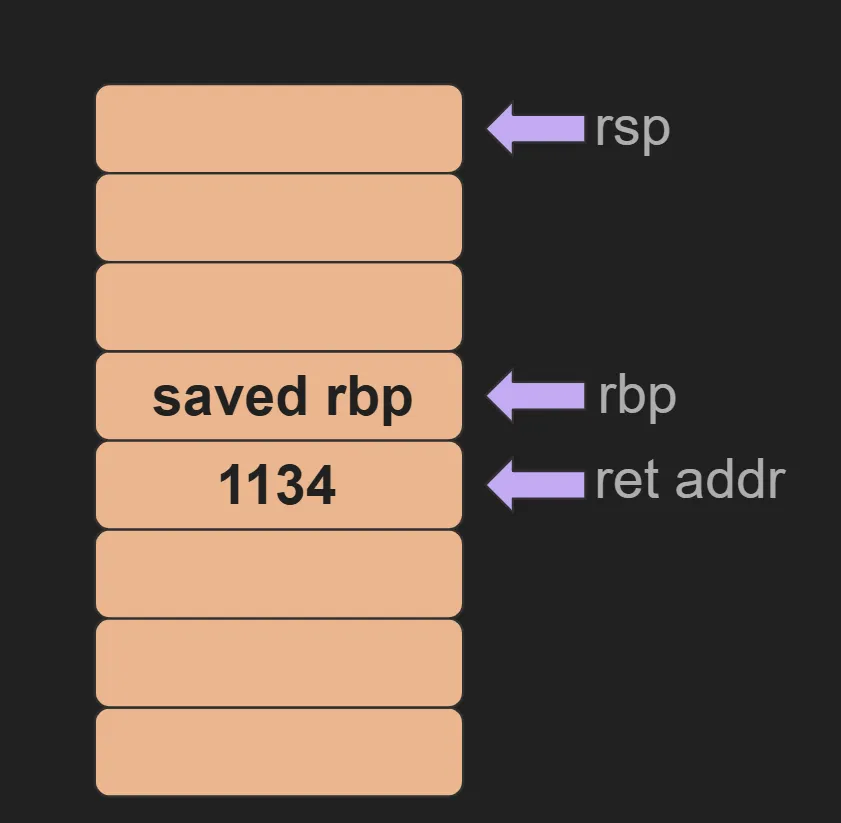
The space between rbp and rsp is inc’s stack frame
Body
Next we enter the function’s main body.
95 collapsed lines
test_program: file format elf64-x86-64
Disassembly of section .init:
0000000000001000 <_init>: 1000: f3 0f 1e fa endbr64 1004: 48 83 ec 08 sub rsp,0x8 1008: 48 8b 05 c1 2f 00 00 mov rax,QWORD PTR [rip+0x2fc1] # 3fd0 <__gmon_start__@Base> 100f: 48 85 c0 test rax,rax 1012: /-- 74 02 je 1016 <_init+0x16> 1014: | ff d0 call rax 1016: \-> 48 83 c4 08 add rsp,0x8 101a: c3 ret
Disassembly of section .plt:
0000000000001020 <.plt>: 1020: ff 35 ca 2f 00 00 push QWORD PTR [rip+0x2fca] # 3ff0 <_GLOBAL_OFFSET_TABLE_+0x8> 1026: ff 25 cc 2f 00 00 jmp QWORD PTR [rip+0x2fcc] # 3ff8 <_GLOBAL_OFFSET_TABLE_+0x10> 102c: 0f 1f 40 00 nop DWORD PTR [rax+0x0]
Disassembly of section .plt.got:
0000000000001030 <__cxa_finalize@plt>: 1030: ff 25 aa 2f 00 00 jmp QWORD PTR [rip+0x2faa] # 3fe0 <__cxa_finalize@GLIBC_2.2.5> 1036: 66 90 xchg ax,ax
Disassembly of section .text:
0000000000001040 <_start>: 1040: f3 0f 1e fa endbr64 1044: 31 ed xor ebp,ebp 1046: 49 89 d1 mov r9,rdx 1049: 5e pop rsi 104a: 48 89 e2 mov rdx,rsp 104d: 48 83 e4 f0 and rsp,0xfffffffffffffff0 1051: 50 push rax 1052: 54 push rsp 1053: 45 31 c0 xor r8d,r8d 1056: 31 c9 xor ecx,ecx 1058: 48 8d 3d c7 00 00 00 lea rdi,[rip+0xc7] # 1126 <main> 105f: ff 15 5b 2f 00 00 call QWORD PTR [rip+0x2f5b] # 3fc0 <__libc_start_main@GLIBC_2.34> 1065: f4 hlt
0000000000001066 <deregister_tm_clones>: 1066: 48 8d 3d a3 2f 00 00 lea rdi,[rip+0x2fa3] # 4010 <__TMC_END__> 106d: 48 8d 05 9c 2f 00 00 lea rax,[rip+0x2f9c] # 4010 <__TMC_END__> 1074: 48 39 f8 cmp rax,rdi 1077: /-- 74 0e je 1087 <deregister_tm_clones+0x21> 1079: | 48 8b 05 48 2f 00 00 mov rax,QWORD PTR [rip+0x2f48] # 3fc8 <_ITM_deregisterTMCloneTable@Base> 1080: | 48 85 c0 test rax,rax 1083: +-- 74 02 je 1087 <deregister_tm_clones+0x21> 1085: | ff e0 jmp rax 1087: \-> c3 ret
0000000000001088 <register_tm_clones>: 1088: 48 8d 3d 81 2f 00 00 lea rdi,[rip+0x2f81] # 4010 <__TMC_END__> 108f: 48 8d 35 7a 2f 00 00 lea rsi,[rip+0x2f7a] # 4010 <__TMC_END__> 1096: b9 02 00 00 00 mov ecx,0x2 109b: 48 29 fe sub rsi,rdi 109e: 48 c1 fe 03 sar rsi,0x3 10a2: 48 89 f0 mov rax,rsi 10a5: 48 99 cqo 10a7: 48 f7 f9 idiv rcx 10aa: 48 89 c6 mov rsi,rax 10ad: 48 85 c0 test rax,rax 10b0: /-- 74 0e je 10c0 <register_tm_clones+0x38> 10b2: | 48 8b 05 1f 2f 00 00 mov rax,QWORD PTR [rip+0x2f1f] # 3fd8 <_ITM_registerTMCloneTable@Base> 10b9: | 48 85 c0 test rax,rax 10bc: +-- 74 02 je 10c0 <register_tm_clones+0x38> 10be: | ff e0 jmp rax 10c0: \-> c3 ret
00000000000010c1 <__do_global_dtors_aux>: 10c1: f3 0f 1e fa endbr64 10c5: 80 3d 44 2f 00 00 00 cmp BYTE PTR [rip+0x2f44],0x0 # 4010 <__TMC_END__> 10cc: /----- 75 28 jne 10f6 <__do_global_dtors_aux+0x35> 10ce: | 55 push rbp 10cf: | 48 83 3d 09 2f 00 00 cmp QWORD PTR [rip+0x2f09],0x0 # 3fe0 <__cxa_finalize@GLIBC_2.2.5> 10d6: | 00 10d7: | 48 89 e5 mov rbp,rsp 10da: | /-- 74 0c je 10e8 <__do_global_dtors_aux+0x27> 10dc: | | 48 8b 3d 25 2f 00 00 mov rdi,QWORD PTR [rip+0x2f25] # 4008 <__dso_handle> 10e3: | | e8 48 ff ff ff call 1030 <__cxa_finalize@plt> 10e8: | \-> e8 79 ff ff ff call 1066 <deregister_tm_clones> 10ed: | c6 05 1c 2f 00 00 01 mov BYTE PTR [rip+0x2f1c],0x1 # 4010 <__TMC_END__> 10f4: | 5d pop rbp 10f5: | c3 ret 10f6: \----> c3 ret
00000000000010f7 <frame_dummy>: 10f7: f3 0f 1e fa endbr64 10fb: eb 8b jmp 1088 <register_tm_clones>
00000000000010fd <inc>:
10fd: 55 push rbp 10fe: 48 89 e5 mov rbp,rsp 1101: 48 83 ec 18 sub rsp,0x18 1105: 48 89 7d e8 mov QWORD PTR [rbp-0x18],rdi 1109: 48 c7 45 f8 01 00 00 mov QWORD PTR [rbp-0x8],0x1 1110: 00 1111: 48 8b 55 e8 mov rdx,QWORD PTR [rbp-0x18] 1115: 48 8b 45 f8 mov rax,QWORD PTR [rbp-0x8] 1119: 48 01 d0 add rax,rdx 111c: 48 89 45 f0 mov QWORD PTR [rbp-0x10],rax 1120: 48 8b 45 f0 mov rax,QWORD PTR [rbp-0x10]
1124: c9 leave 1125: c3 ret
16 collapsed lines
0000000000001126 <main>: 1126: 55 push rbp 1127: 48 89 e5 mov rbp,rsp 112a: bf 05 00 00 00 mov edi,0x5 112f: e8 c9 ff ff ff call 10fd <inc> 1134: b8 00 00 00 00 mov eax,0x0 1139: 5d pop rbp 113a: c3 ret
Disassembly of section .fini:
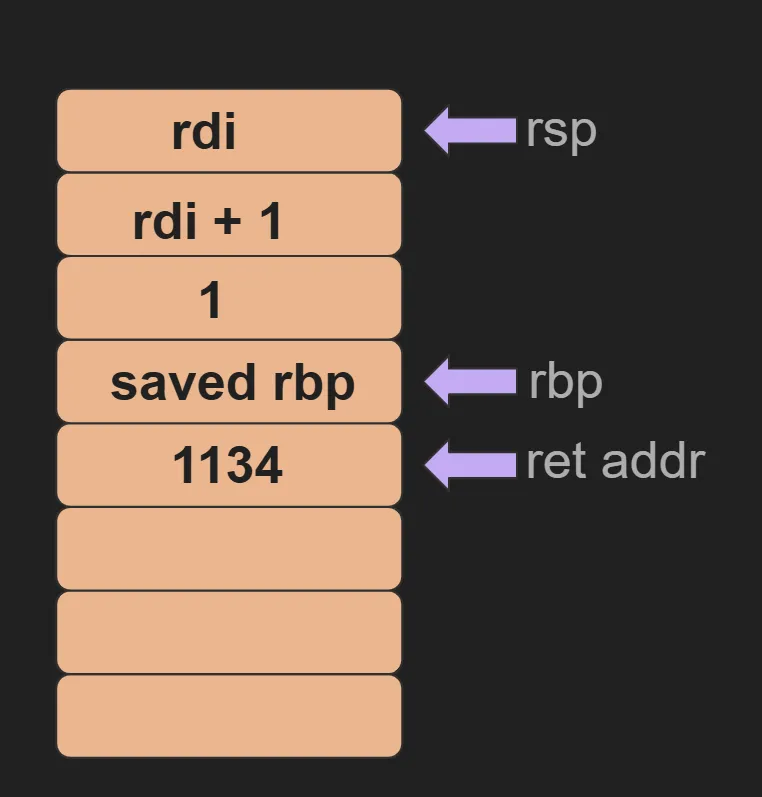
000000000000113c <_fini>: 113c: f3 0f 1e fa endbr64 1140: 48 83 ec 08 sub rsp,0x8 1144: 48 83 c4 08 add rsp,0x8 1148: c3 retFirst we move rdi to rbp-0x18. If you recall, rdi is the register used to store the first argument in the function and rbp-0x18 is where rsp is currently pointing to. Next we move 0x1 to rbp-0x8. Looking back at the C code, we can tell that this basiclly coresponds to the line long incrementer = 1; . This way we can see that indeed local variables are stored on the stack.
I’ll move pass a couple instructions quickly. We move rbp-0x18 (rdi) to rdx, then move rbp-0x8 (1) to rax, after that we add them both together then move the result into rbp-0x10 and finally move the value inside rbp-0x10 into rax.
Note
-
In assembly, the add instruction uses the following format
add reg1,reg2. This will add the contents of reg1 with reg2 then store the result into reg1. -
The reason why we move the value of
raxtorbp-0x10and then back toraxagain is becauseraxis used to store the return value of a function and we can check on the C code that the function returns the result of the addition
After the body, here is what the stack looks like
Epilouge
We finally reach the Epilouge of inc
95 collapsed lines
test_program: file format elf64-x86-64
Disassembly of section .init:
0000000000001000 <_init>: 1000: f3 0f 1e fa endbr64 1004: 48 83 ec 08 sub rsp,0x8 1008: 48 8b 05 c1 2f 00 00 mov rax,QWORD PTR [rip+0x2fc1] # 3fd0 <__gmon_start__@Base> 100f: 48 85 c0 test rax,rax 1012: /-- 74 02 je 1016 <_init+0x16> 1014: | ff d0 call rax 1016: \-> 48 83 c4 08 add rsp,0x8 101a: c3 ret
Disassembly of section .plt:
0000000000001020 <.plt>: 1020: ff 35 ca 2f 00 00 push QWORD PTR [rip+0x2fca] # 3ff0 <_GLOBAL_OFFSET_TABLE_+0x8> 1026: ff 25 cc 2f 00 00 jmp QWORD PTR [rip+0x2fcc] # 3ff8 <_GLOBAL_OFFSET_TABLE_+0x10> 102c: 0f 1f 40 00 nop DWORD PTR [rax+0x0]
Disassembly of section .plt.got:
0000000000001030 <__cxa_finalize@plt>: 1030: ff 25 aa 2f 00 00 jmp QWORD PTR [rip+0x2faa] # 3fe0 <__cxa_finalize@GLIBC_2.2.5> 1036: 66 90 xchg ax,ax
Disassembly of section .text:
0000000000001040 <_start>: 1040: f3 0f 1e fa endbr64 1044: 31 ed xor ebp,ebp 1046: 49 89 d1 mov r9,rdx 1049: 5e pop rsi 104a: 48 89 e2 mov rdx,rsp 104d: 48 83 e4 f0 and rsp,0xfffffffffffffff0 1051: 50 push rax 1052: 54 push rsp 1053: 45 31 c0 xor r8d,r8d 1056: 31 c9 xor ecx,ecx 1058: 48 8d 3d c7 00 00 00 lea rdi,[rip+0xc7] # 1126 <main> 105f: ff 15 5b 2f 00 00 call QWORD PTR [rip+0x2f5b] # 3fc0 <__libc_start_main@GLIBC_2.34> 1065: f4 hlt
0000000000001066 <deregister_tm_clones>: 1066: 48 8d 3d a3 2f 00 00 lea rdi,[rip+0x2fa3] # 4010 <__TMC_END__> 106d: 48 8d 05 9c 2f 00 00 lea rax,[rip+0x2f9c] # 4010 <__TMC_END__> 1074: 48 39 f8 cmp rax,rdi 1077: /-- 74 0e je 1087 <deregister_tm_clones+0x21> 1079: | 48 8b 05 48 2f 00 00 mov rax,QWORD PTR [rip+0x2f48] # 3fc8 <_ITM_deregisterTMCloneTable@Base> 1080: | 48 85 c0 test rax,rax 1083: +-- 74 02 je 1087 <deregister_tm_clones+0x21> 1085: | ff e0 jmp rax 1087: \-> c3 ret
0000000000001088 <register_tm_clones>: 1088: 48 8d 3d 81 2f 00 00 lea rdi,[rip+0x2f81] # 4010 <__TMC_END__> 108f: 48 8d 35 7a 2f 00 00 lea rsi,[rip+0x2f7a] # 4010 <__TMC_END__> 1096: b9 02 00 00 00 mov ecx,0x2 109b: 48 29 fe sub rsi,rdi 109e: 48 c1 fe 03 sar rsi,0x3 10a2: 48 89 f0 mov rax,rsi 10a5: 48 99 cqo 10a7: 48 f7 f9 idiv rcx 10aa: 48 89 c6 mov rsi,rax 10ad: 48 85 c0 test rax,rax 10b0: /-- 74 0e je 10c0 <register_tm_clones+0x38> 10b2: | 48 8b 05 1f 2f 00 00 mov rax,QWORD PTR [rip+0x2f1f] # 3fd8 <_ITM_registerTMCloneTable@Base> 10b9: | 48 85 c0 test rax,rax 10bc: +-- 74 02 je 10c0 <register_tm_clones+0x38> 10be: | ff e0 jmp rax 10c0: \-> c3 ret
00000000000010c1 <__do_global_dtors_aux>: 10c1: f3 0f 1e fa endbr64 10c5: 80 3d 44 2f 00 00 00 cmp BYTE PTR [rip+0x2f44],0x0 # 4010 <__TMC_END__> 10cc: /----- 75 28 jne 10f6 <__do_global_dtors_aux+0x35> 10ce: | 55 push rbp 10cf: | 48 83 3d 09 2f 00 00 cmp QWORD PTR [rip+0x2f09],0x0 # 3fe0 <__cxa_finalize@GLIBC_2.2.5> 10d6: | 00 10d7: | 48 89 e5 mov rbp,rsp 10da: | /-- 74 0c je 10e8 <__do_global_dtors_aux+0x27> 10dc: | | 48 8b 3d 25 2f 00 00 mov rdi,QWORD PTR [rip+0x2f25] # 4008 <__dso_handle> 10e3: | | e8 48 ff ff ff call 1030 <__cxa_finalize@plt> 10e8: | \-> e8 79 ff ff ff call 1066 <deregister_tm_clones> 10ed: | c6 05 1c 2f 00 00 01 mov BYTE PTR [rip+0x2f1c],0x1 # 4010 <__TMC_END__> 10f4: | 5d pop rbp 10f5: | c3 ret 10f6: \----> c3 ret
00000000000010f7 <frame_dummy>: 10f7: f3 0f 1e fa endbr64 10fb: eb 8b jmp 1088 <register_tm_clones>
00000000000010fd <inc>:
10fd: 55 push rbp 10fe: 48 89 e5 mov rbp,rsp 1101: 48 83 ec 18 sub rsp,0x18 1105: 48 89 7d e8 mov QWORD PTR [rbp-0x18],rdi 1109: 48 c7 45 f8 01 00 00 mov QWORD PTR [rbp-0x8],0x1 1110: 00 1111: 48 8b 55 e8 mov rdx,QWORD PTR [rbp-0x18] 1115: 48 8b 45 f8 mov rax,QWORD PTR [rbp-0x8] 1119: 48 01 d0 add rax,rdx 111c: 48 89 45 f0 mov QWORD PTR [rbp-0x10],rax 1120: 48 8b 45 f0 mov rax,QWORD PTR [rbp-0x10]
1124: c9 leave 1125: c3 ret
16 collapsed lines
0000000000001126 <main>: 1126: 55 push rbp 1127: 48 89 e5 mov rbp,rsp 112a: bf 05 00 00 00 mov edi,0x5 112f: e8 c9 ff ff ff call 10fd <inc> 1134: b8 00 00 00 00 mov eax,0x0 1139: 5d pop rbp 113a: c3 ret
Disassembly of section .fini:
000000000000113c <_fini>: 113c: f3 0f 1e fa endbr64 1140: 48 83 ec 08 sub rsp,0x8 1144: 48 83 c4 08 add rsp,0x8 1148: c3 retThe epilouge would usually contain two instructions, leave and ret. Let’s see what each instruction does.
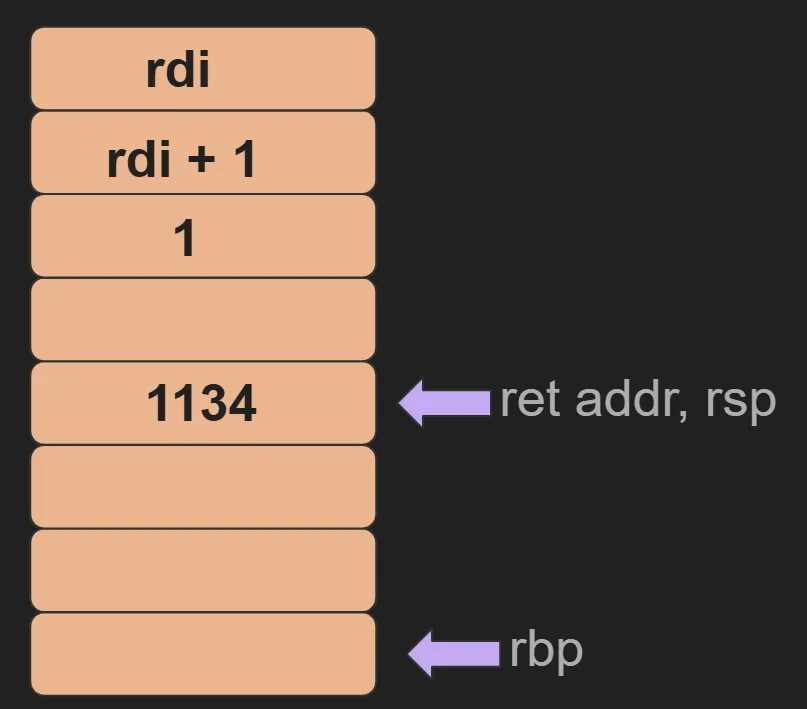
leave is basically a shorthand for mov rsp, rbp; pop rbp . It first moves rbp to rsp.
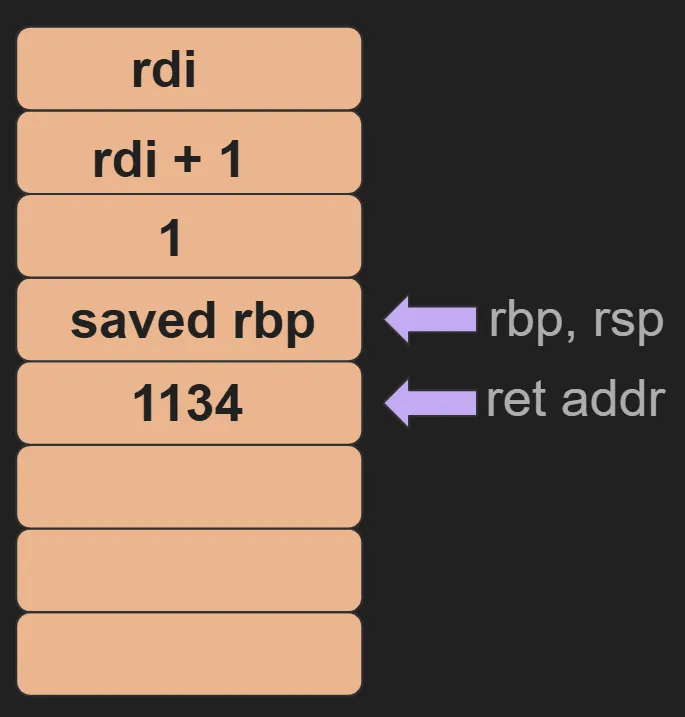
After that it pops a value and put it into rbp. Pop will pop the whatever value is in the address that is in rsp. In this case, its the saved rbp. This effectively tears down the stack frame of inc
Note
If you have been following, you would notice the the local variables and other stuffs that are put on the stack during the function body isn’t actually deleted.
The ret instruction would pop a value of the stack and then jumps to that value. Since we know that rsp points to the return address, ret will pop the return address and then jump to it, continueing program execution.
Buffer Overflows
Take a look at the C program
#include <stdio.h>
void store() { char buffer[20]; printf("Enter a string"); gets(buffer);}
int main() { store(); return 0;}Do you notice anything wrong? The gets function is a dangerous function because it does not check the size of the buffer. This means that if we enter a string longer than 20 characters, it will still happily put it into a buffer.
Now why is this dangerous? Well because we could overwrite important values. Let’s take a look at the stack.
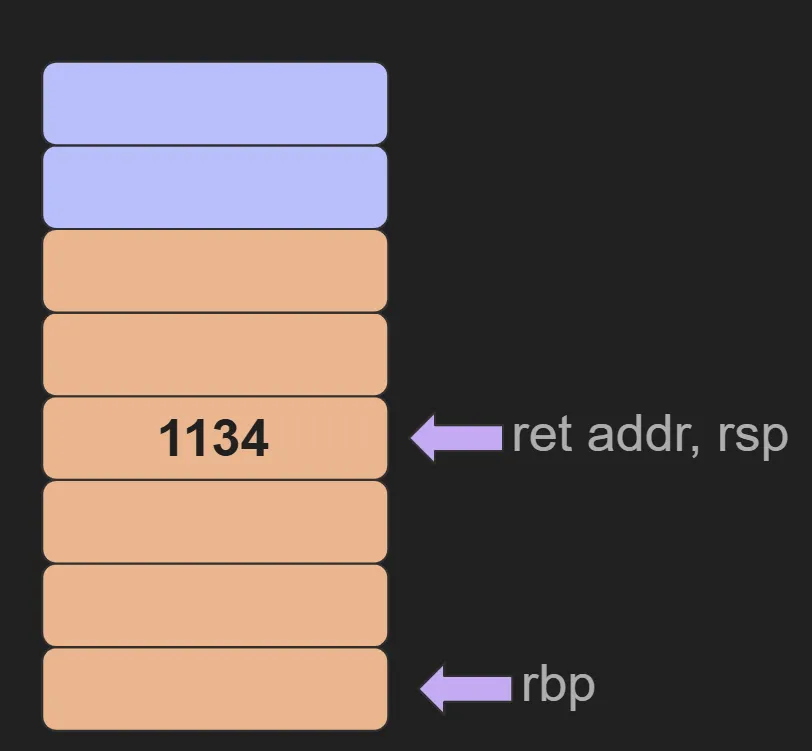
The blue part is the buffer. Although the stack grows downward towards region of lower memory, the buffer is written on the opposite direction, upwards towards region of higher memory. So what would happen if we input a very long string of A’s
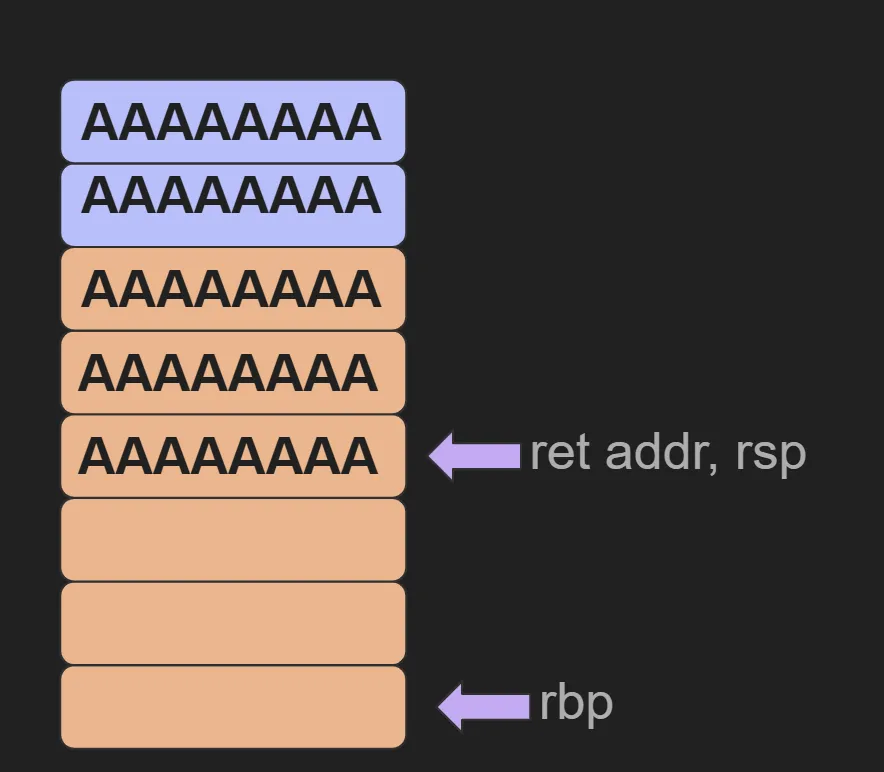
We’ve overwritten the return address! This means that when the function finished executing, it will jump to an invalid address and crash. That is a buffer overflow. Now in this case all the program does is crash but if we craft our payload carefully, we could do more malicious things. However, that is out of scope of this blog post.
Final Remarks
That wraps up this blog post. This is the very basic foundational knowledge for binary exploitation and there are still a lot of other foundational knowledge that I didn’t cover on this post. If binex is something that interests you, I would recommend checking out the goated learning platform pwn.college. That’s all from me, thanks for reading!
References
https://pwn.college/
https://chatgpt.com/
https://math.hws.edu/eck/cs220/f22/registers.html
https://web.stanford.edu/class/cs107/guide/x86-64.html